
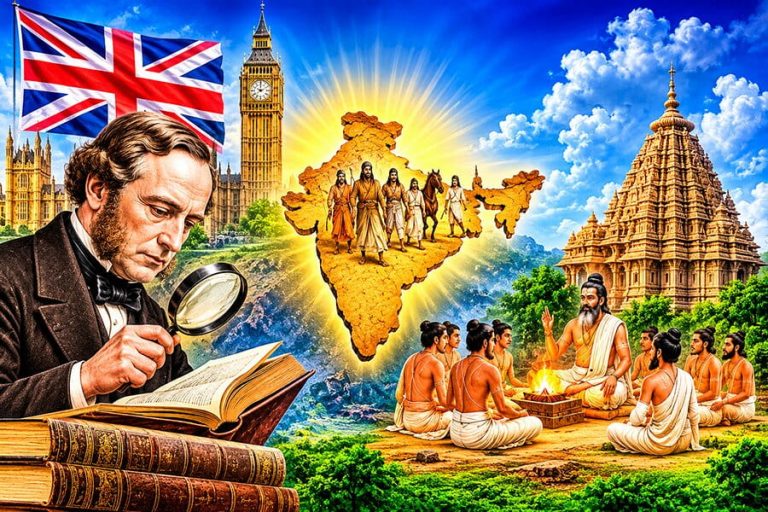
Balangir: 20 November 2026: Even after many foreign invaders kept the Indian subcontinent enslaved for thousands of years, they were forced to leave the country due to the resistance of its indigenous inhabitants.
On the other hand, foreign invaders of the Aryan race from Central Asia—who introduced the caste system in the country and became Brahmins—have been cruelly oppressing and exploiting Indians for thousands of years. Yet, through the complicity and cooperation of indigenous inhabitants here, they have kept the country enslaved, whose methods astonished the British government of that time.
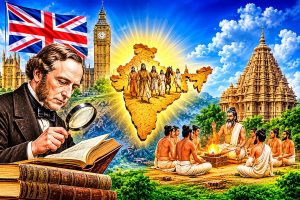
Many British officers and scholars appointed by the British government conducted extensive research during the nineteenth and twentieth centuries on the underlying strategies, plans, and methods of the Aryan race.
Although the subject matter of the British government’s research on the Brahmanists of the foreign Aryan race is very complex and extensive, because it is connected to the future of India, it is essential for every citizen at home and abroad to know about it.
To know the detailed facts related to this, you need to understand the following topics:
(a) The prominent British officers and scholars who researched the “Aryan Invasion Theory” on behalf of the British government, as well as the underlying purpose of having this research conducted and the evidentiary findings obtained.
(b) Brahmanists of the foreign Aryan race joining hands with the British government to capture governing power in India, assassinating Mahatma Gandhi out of vengeance after failing, and the underlying purpose and core objective of the Brahmanists after seizing governing power in the country.
The above topics are presented in detail below.
(1) Evidentiary Findings of the British Government’s Research :
After researching the Aryan race, British officers and scholars first presented evidentiary findings on the following points to the British government:
(a) Pastoralist and chariot-driving nomadic groups fled from many countries such as Turkmenistan, Kazakhstan, and Uzbekistan, and settled in Central Asia. Due to a severe lack of rainfall, the land in the region turned desert-like.
(b) As living there became impossible for them, they left their homeland and migrated from Central Asia to (i) the Indian subcontinent, Nepal, Bhutan, and Sri Lanka in the south; (ii) Iran, Syria, and Turkey in the west; and (iii) Afghanistan and various countries near Central Asia.
(c) Traveling through the Khyber Pass along the Silk Road, bringing chariots, horses, copper and bronze weapons, various animals and birds, and the Rigveda, they first arrived in the Indus Valley around 2000–1800 BCE.
(d) Attacking the ancient Indus Valley Civilization of the Indian subcontinent located there and brutally massacring the indigenous inhabitants of the peaceful land, people fled in fear for their lives toward the southern part of the country (South India).
(e) After bringing the Indus Valley under their control, they destroyed the ancient civilization and culture of the Indian subcontinent. They named themselves the “Aryan” race (meaning “noble” or “superior” in Sanskrit). Later, around 1500–1000 BCE, they first introduced Vedic culture and the caste system in the country and became Brahmins.
(f) People of the so-called Aryan race introduced Brahmanism and the caste system in the country based on caste divisions, dividing the indigenous people of the Indian subcontinent into various castes and governing them under their control.
(g) Later, by creating imaginary deities—Brahma, Vishnu, Maheshwara, Rama, Parashurama, Hanuman, Krishna, Balarama, thirty-three crore deities, and avatars of Vishnu—they filled the minds of people in the country with superstition and regressive customs.
(h) According to all the British officers and scholars conducting the research, through the caste system, superstitions, and regressive customs created in the name of imaginary deities in India, the true inhabitants of the Indian subcontinent were confined to religious bondage. Because of this, the indigenous people of the country were compelled to accept servitude instead of protesting.
(2) Biography, Research, and Contributions to Aryan Theory of Sir William Jones :
(a) Founding the Asiatic Society in Calcutta for Research :
Professional Background and Arrival in India: Sir William Jones was a renowned British (Anglo-Welsh) philologist, jurist, and Orientalist. Appointed by the British East India Company as a Puisne Judge of the Supreme Court in Calcutta, he arrived in India in 1783.
Founding the Asiatic Society: To conduct research on Indian history, literature, and science, he founded The Asiatic Society of Bengal in Calcutta in 1784.
(b) Linguistic Research and Historical Discoveries :
Learning Sanskrit: To better understand Indian law and religious texts, he learned Sanskrit in India from pandits.
Famous Address of 1786: Speaking at the Asiatic Society on 2 February 1786, he stated that the structure of the Sanskrit language is remarkably refined and richer than Greek and Latin.
Common Source of Sanskrit: He demonstrated deep similarities in vocabulary and grammar between Sanskrit and Greek, Latin, Gothic, and Persian. He posited that all these languages originated from an ancient common ancestral language (Proto-Indo-European).
(c) Views on Aryan Theory and Indian History :
Jones suggested that if European and Indian languages share a common source, the ancestors of those who spoke these languages also lived in one place in ancient times, later dispersing in different directions.
Although Jones did not directly use the word “invasion,” based on his linguistic hypothesis, later British and German researchers (such as Max Müller) claimed that Europeans and upper-caste Indians were descendants of a single “Aryan race.”
Jones and his followers viewed Indian society as divided between Aryans who came from outside and the indigenous inhabitants here (Dravidians or non-Aryans). In their view, upper-caste people came from outside and bound India’s indigenous inhabitants in the religious slavery of the caste system and Brahmanism.
Bridge Between East and West: By translating works such as Kalidasa’s Abhijnanashakuntalam and the Manusmriti into English, he introduced the Western world to the oppressive and exploitative practices of the caste system and Brahmanism within Indian Brahmanical culture.
(3) Friedrich Max Müller :
Introduction: He was German by birth, but worked under the British East India Company and Oxford University. He is called the father of modern Vedic studies.
Work and Research: With financial support from the East India Company, he edited and translated the Rigveda into English between 1849 and 1874. Estimating the composition period of the Vedas to be roughly 1200 to 1500 BCE, Max Müller presented the following evidentiary findings:
Rigveda and Avesta: There are striking similarities in language, grammar, and names of deities (such as Mitra, Varuna, and Indra) between the ancient Iranian religious text Zend Avesta and India’s Rigveda. The common origin of these two language groups lay in the “Proto-Indo-Iranian” community of Central Asia, which later split, with some moving to Iran and some to India (the Indus Valley region).
Cultural Vocabulary: Terms used in Vedic Sanskrit such as chariot (Ratha), horse (Asva), and Somarasa align with archaeological findings of Central Asia’s ancient Andronovo Culture, whose people first began using horse-drawn chariots.
English Translation of Texts: He also edited around 50 prominent Brahmanical texts in English in the series Sacred Books of the East. In his book, he noted that in the Vedic Samhita or Rigveda, the king of gods, Indra, is called Purandara (meaning destroyer of forts or cities). Based on this term, he argued that in the name of Indra, Aryans termed it a religious act and attacked and destroyed the forts and cities of the Indus civilization.
Views on Aryan Theory: Max Müller first popularized the term “Aryan” not merely as a language family, but as a “race.” He argued that around 2000 to 1800 BCE, Aryans from Central Asia attacked the forts and cities of the Indus civilization in northwestern India, defeated its indigenous inhabitants, and pushed them toward South India.
(4) Sir Herbert Hope Risley :
Introduction: He was a British ICS (Indian Civil Service) officer, anthropologist, and the Commissioner of the 1901 Census of India.
Work and Research: Risley used the “Nasal Index” (a method of measuring nose shape and skull structure) to link the Indian caste system with the “Aryan Invasion Theory.” In 1891 he wrote The Tribes and Castes of Bengal, and in 1908 The People of India.
Views on Aryan Theory: He claimed that the nose shape and physical build of Indians were linked to their social status. In his view, those with long, narrow noses (upper castes) were descendants of “Aryans” who came from outside. Conversely, those with flat, broad noses (lower castes and Adivasis) were indigenous “Dravidians” of India. In the 1901 census, he classified castes on this basis, creating divisions in Indian society.
(5) Robert Caldwell :
Introduction: He was a British Christian missionary and linguist who worked for many years in Tirunelveli in South India.
Work and Research: In 1856 he wrote a famous book titled A Comparative Grammar of the Dravidian or South-Indian Family of Languages, in which he first introduced the concept of the “Dravidian” language family.
Views on Aryan Theory: Caldwell argued that South Indian languages (Tamil, Telugu, Kannada, Malayalam) are completely distinct from Sanskrit. He propagated that Brahmins or Aryans from North India exploited the indigenous Dravidians of South India and imposed their culture and caste system. This theory later laid the foundation for Aryan–Dravidian political disputes in South India.
(6) Sir Mortimer Wheeler :
Introduction: He was a British military officer and archaeologist who served as Director-General of the Archaeological Survey of India (ASI) from 1944 to 1948.
Work and Research: He led excavations at Indus Valley Civilization sites such as Harappa and Mohenjo-daro.
Views on Aryan Theory: Observing human skeletal remains found during excavations at Mohenjo-daro, Wheeler concluded that the decline of the Indus civilization was not due to natural disasters, but to a violent invasion by Aryans. He held the Vedic deity “Indra” (Purandara, or destroyer of forts) responsible for destroying the Indus civilization.
(7) Main Objectives of the British Government’s Research :
(a) Dividing Indian Society into Two Camps: To check foreign invaders of the Aryan race, they divided Indian society—Aryan race versus indigenous inhabitants, North versus South, Aryan versus Dravidian, and upper caste versus lower caste—splitting it into two groups based on census classifications. Their core aim was to expel foreign Brahmanists from the country if they raised their voice against British rule.
(b) Proposal of Cooperation to India’s Indigenous Inhabitants: They sought to show that a superior race coming from outside had always ruled India. They proposed that if India’s indigenous inhabitants cooperated with the British government, the caste system and Brahmanical bondage would be abolished from the Indian subcontinent, freeing the people from the oppression and exploitation of the Aryan race.
(8) Cooperation of People of the Foreign Aryan Race with the British Government :
India’s indigenous inhabitants rejected the British government’s proposal, whereas people of the foreign Aryan race extended a hand of cooperation.
(a) While hundreds of thousands of Indians sacrificed their lives in India’s freedom struggle, the strategy of Brahmanical Hindu and Sanatanist organizations run by foreign Aryans at that time differed from the mainstream of the independence movement. Their priority leaned more toward internal religious and social organization than freedom from British imperialism, which remains a subject of historical discussion.
(b) During major phases of the independence movement—especially the Non-Cooperation Movement, Civil Disobedience Movement, and Quit India Movement led by Mahatma Gandhi—certain Hindu organizations led by Brahmanists at that time did not directly join the anti-British struggle.
(c) During the 1942 Quit India Movement, when the entire country took to the streets against the British government, the leadership of the Hindu Mahasabha and Brahmanical Hindu organizations called on their organizations to stay away from the movement.
(9) Forming Coalition Governments with the British Government and Supporting World War II
(a) Coalition Governments: In 1939–1940, when Congress leaders resigned from government in protest against the British, the Hindu Mahasabha formed coalition governments with the Muslim League in Sindh, Bengal, and the North-West Frontier Province.
(b) Army Recruitment Policy: During World War II, Brahmanical Hindu organizations supported recruiting Indians into the British army, contrary to the Congress’s anti-British policy.
(10) Communal Riots and an Atmosphere of Hatred :
(a) Behind the communal riots that occurred at the time of Partition lay not merely a struggle for political power, but the expression of an organized communal mindset. Before independence, the Hindu Mahasabha and hardline Brahmanical organizations fostered hatred and distrust against other communities in the name of uniting Hindu society.
(b) These organizations’ so-called “cultural awakening movements” deepened divisions at the social level. Under the influence of Brahmanical ideology, minority communities were viewed with suspicion and hostility, which became a backdrop to India’s partition and played a major role in inflaming riots at that time.
(11) Aspiration to Establish a “Hindu Rashtra” and the Background to Partition :
(a) The darkest and most poignant chapter in the history of Indian independence is the Partition of 1947. After Louis Mountbatten announced on 3 June 1947 that independence would be granted soon, the country became independent on 15 August 1947 under the Indian Independence Act. However, serious disputes emerged in the country’s political atmosphere alongside independence.
(b) Because Brahmanists of the Aryan race had provided all kinds of cooperation during British rule, they exerted heavy pressure on the Governor-General of the time to hand over power to them after independence was announced, but failed because they did not receive Mahatma Gandhi’s support.
(c) At that time, Brahmanical Hindu organizations insisted on enshrining the country in the Constitution as a “Hindu Rashtra.” Their main objective was to re-establish that old Brahmanical system, varnashrama, and exploitative social structure in the Constitution of independent India.
(d) However, the Muslim community and other stakeholders were unwilling under any circumstances to accept such Brahmanical dominance and religious narrow-mindedness. This ideological conflict and hardline politics shattered the dream of a united India, and the country was divided into India and Pakistan.
(e) This partition was not merely a division of territory, but a flood of intolerance, hatred, and communal violence in which over 10 lakh (one million) innocent people lost their lives. These terrible communal riots and the partition were the outcome of the distorted mindset of certain hardline Brahmanical Hindu organizations, recorded as a blemished chapter in history.
(12) Mahatma Gandhi’s Opposition and Hardliners’ Reaction :
(a) While lakhs of people were losing their lives in nationwide communal riots, Mahatma Gandhi undertook a fast unto death to preserve communal harmony, peace, and secularism. Starting his fast in Delhi on 12 January 1948, he succeeded in bringing the riots to a complete halt. However, hardline Brahmanical Hindu organization groups could not tolerate this peace effort.
(b) Secularism and Constitution-Making: Because of Mahatma Gandhi’s firm intervention and farsighted approach, India was saved from becoming a communal state of Brahmanists of the Aryan race and became a secular state with equal respect for all religions. In addition, in Prime Minister Jawaharlal Nehru’s government, Dr. B. R. Ambedkar was appointed Law Minister and entrusted on 29 August 1947 with the major responsibility of chairing the Constitution Drafting Committee.
(13) Assassination of Gandhiji by Foreign Brahmanists :
(a) Because Gandhiji played a central role in India becoming a secular state and Dr. Ambedkar receiving the chief responsibility for drafting the Constitution, hardline Brahmanical Hindu organizations grew angry with him.
(b) Because Gandhiji stood in the way of their objective of establishing Brahmanism in the Constitution under the name of a “Hindu Rashtra” and strongly supported communal harmony and secularism in the country, they became vengeful.
(c) As a result, a bomb was thrown at Gandhiji’s prayer meeting at Birla House on 20 January 1948, and finally Mahatma Gandhi was brutally assassinated on 30 January 1948 by Nathuram Godse—a Brahmanist of the foreign Aryan race—and others. This tragic event in Indian history remains a dark chapter of communal intolerance and hardline ideology.
(14) Governing Power in the Hands of Foreign Brahmanists and Threat to the Constitution :
(a) Although Brahmanists of the foreign Aryan race have oppressed and exploited the country’s indigenous inhabitants in India for thousands of years, they have succeeded at various times (such as 1996, 1998, 1999, 2014, 2019, and 2024) in capturing governing power in the country.
(b) The Constitution stands as an obstacle to keeping the Indian subcontinent permanently subjugated and enslaved. Removing reservation provisions in the Constitution for SC, ST, and OBC communities and the designation of a secular state to establish Brahmanism under the name of a Hindu Rashtra has become the core goal of their lives.
(c) At such a critical juncture, it is the call of the hour for every citizen who considers India their motherland to unite—irrespective of party affiliation, caste, or varna—and raise their voice and protest against the anti-national conspiracies of Brahmanists of the foreign Aryan race. If the Constitution is altered, India will once again become subjugated and enslaved, and the country’s future will be plunged into darkness forever.