




Balangir: November 7, 2025 : In past times, the caste system had taken an aggressive form in society. Child marriage was prevalent in the Brahmin society, and widowhood remarriage was strictly prohibited.
In the Brahmin society, many young girls became widows at a very early age following child marriage or regular marriage. After becoming a widow, no one would accept them in society. Often, widowed girls would elope with boys from other castes. If a widowed girl eloped with a boy from another caste, she, along with her family members, was considered a Shudra in society and was subjected to social ostracization.
As such situations gradually grew more complex in society, family members of widows of all ages—invoking religion—would burn them alive on the funeral pyre alongside their dead husbands under the name of the Sati system.
To know detailed information about the Sati system, one needs to understand the exact answers to the following questions thoroughly:
- What was the Sati system?
- What was the religious background of the Sati system?
- How was legislation enacted to abolish the Sati system?
(1) What was the Sati system?
Detailed information regarding this has been presented below for your awareness:
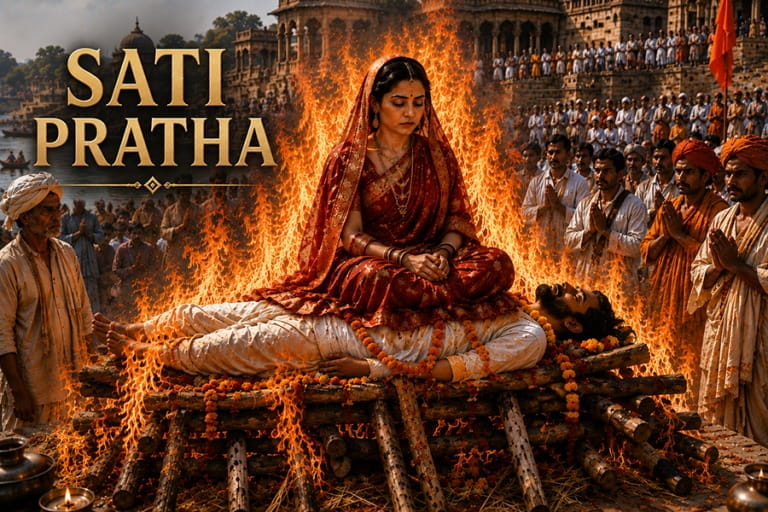
(a) Under the Sati system, after a husband died, his wife was adorned in the attire worn during her wedding. Accompanied by family and members of society playing musical instruments, she was taken in a massive procession to the cremation ground (burning ghat), where she was burned on the funeral pyre with the dead husband’s head resting on her lap. In some cases, instead of burning in fire, burial was practiced. In such situations, a pit was dug, and the wife was buried with the dead husband’s head on her lap.
In some instances, it was the wife’s voluntary decision, but in many situations, women were forced to commit Sati. According to folklore, before taking her to the cremation ground, the wife was kept in seclusion and guarded by family members so she could not escape. Intoxicants were administered to render her numb and unconscious so that she could not offer any protest even if she wished to while being burned.
There are also instances where a wife tried to escape from the funeral pyre, but family members forcibly pushed her back into the fire to burn.
(b) At that time, the Sati system was generally seen in two forms:
- Anumarana: Under this form of Sati, if a husband died while staying in a distant place, his funeral rites were performed there in the wife’s absence. In such a situation, the husband’s ashes or footwear were later placed on the wife’s lap and burned in a fire.
- Sahamarana: Under this form of Sati, the wife was burned directly on her husband’s funeral pyre.
(c) Apart from the above two types, another form of Sati known as “Jauhar” was seen in Rajput society at the time. When Rajput kings and armies died fighting foreign invaders (such as the Mughals), out of fear of falling into enemy hands, their queens, maids, and soldiers’ wives would construct a massive fire pit and jump into it collectively to embrace death.
(d) Brahmins performed all kinds of rituals whenever anyone from any caste died. They propagated widely among all sections of society that performing Sati would wash away all sins and that both husband and wife would attain heaven.
(2) What was the religious background of the Sati system?
Detailed information regarding this has been presented below for your awareness:
(a) According to the mythological legend in the religious background of the Sati system, Goddess Shakti took birth in the form of Devi Sati as the daughter of Daksha Prajapati. From a young age, Devi Sati was constantly attracted to Lord Shiva. When she reached marriageable age, she insisted to her father that she wanted to marry Shiva. Daksha Prajapati did not like Shiva, but yielding to Devi Sati’s resolute willpower, he got her married to Shiva.
(b) Lord Vishnu had granted a boon to Daksha Prajapati that He would protect him under any circumstance. Because of this, Daksha became arrogant and refused to accept Shiva as a god.Some time after Devi Sati’s marriage, Daksha Prajapati organized a grand Yajna (sacrifice) and invited all the deities except Shiva.
When Devi Sati arrived at the sacrificial site uninvited, Daksha Prajapati publicly insulted Shiva with many harsh words. Unable to bear the insult of Shiva, Devi Sati cursed Daksha Prajapati that utter destruction would befall him, and then she plunged into the sacrificial fire pit and sacrificed her life.Following the incident, Lord Shiva sent Virabhadra and Bhadrakali, who killed Daksha Prajapati and destroyed the sacrificial site. Later, Devi Sati was reborn in the form of Parvati and married Shiva.
(c) Using the above mythological legend as a religious background, the following religious sentiments were cultivated in society to favor the practice of Sati:
“Since Devi Sati could not bear her husband’s insult and sacrificed her life by plunging into the fire pit, she was reborn as Parvati in her subsequent life due to her righteous act and married Shiva. If a woman has committed sins in her past life, her husband dies, making her a widow. Therefore, if a Sati-vrata and Pativrata (devoted) woman sacrifices herself on her husband’s funeral pyre after the death of her husband-god, all the sins of herself and her husband will be washed away, both will attain heaven, and they will be reborn as husband and wife once again.”
(d) To make any custom or tradition believable as righteous in the public mind, scriptures and Puranas presented rationalized arguments. Accordingly, the Sati system was also presented as righteous in Indian scriptures and Puranas.
(e) The religious texts mentioning the Sati system as righteous include:
- Garuda Purana, Kurma Purana, Agni Purana, Brahma Purana.
- Brihaspati Smriti, Daksha Smriti, Parasara Smriti, Verse 160, Chapter 5 of Manusmriti.
- Verses 10.18.7 and 10.18.8 of the Rigveda, which were misinterpreted to argue that an anecdote of the Sati system exists in the Vedas as well.
- Additionally, the Sati system is mentioned in the Mahabharata and Ramayana.
There are also allegations that references to Sati were subsequently added to Indian religious texts to legitimize the practice alongside the original texts.
(3) How was legislation enacted to abolish the Sati system?
Detailed information regarding this has been presented below for your awareness:
(a) At that time, social reformer Raja Ram Mohan Roy and several Christian missionaries made continuous efforts to abolish the Sati system in the country.Notably, the sister-in-law (wife’s sister) of Raja Ram Mohan Roy was forcibly burned on her dead husband’s funeral pyre in 1811, which deeply shocked him.
(b) The then British government declared the Sati system illegal in 1798, with prohibitory orders enforced only for Calcutta. However, the Sati practice could not be stopped even in Calcutta through that rule.Later, the then Governor-General Lord William Bentinck declared the Sati system illegal on December 4, 1829, issuing a prohibition across all territories under British rule in India, thereby ending this heinous practice forever.
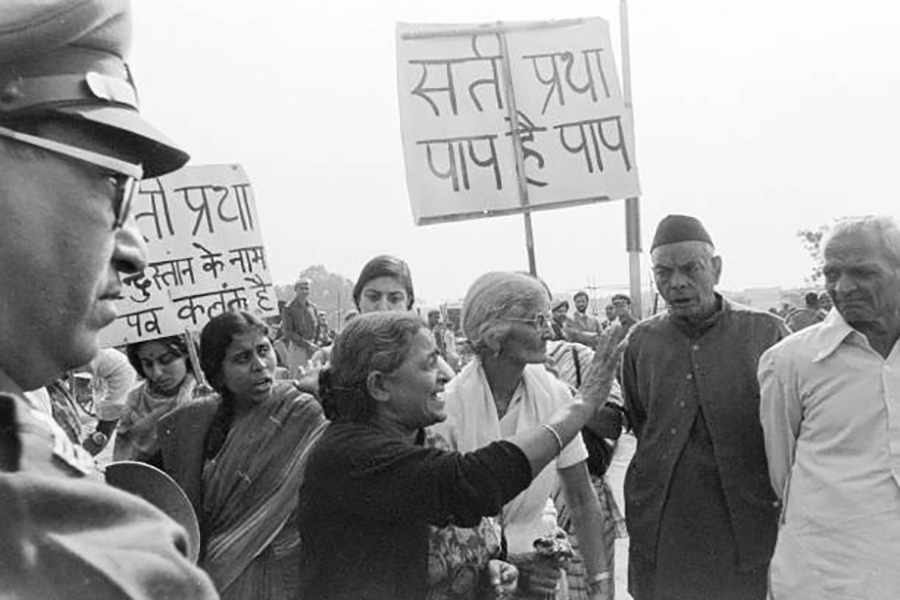
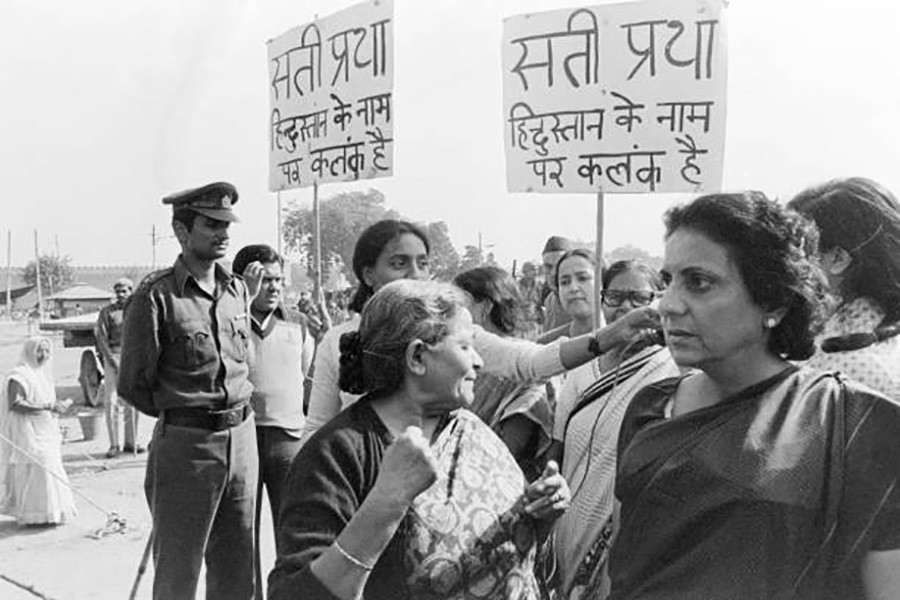
(c) After India gained independence, on September 4, 1987, in a village named Deorala in Rajasthan, an 18-year-old young woman named Roop Kanwar, who had become a widow eight months after her marriage, was burned on the funeral pyre of her dead husband, Mal Singh Shekhawat, in the presence of thousands of people.As widespread public outrage erupted across India over this incident, the Rajasthan government first declared the Sati system illegal, and subsequently, the Government of India enacted legislation named The Commission of Sati (Prevention) Act, 1987, making the Sati practice illegal across the entire country.
Thus, the heinous tradition in which hundreds of thousands of innocent women in India were put to death in fires by their own families in the name of religion came to an end.