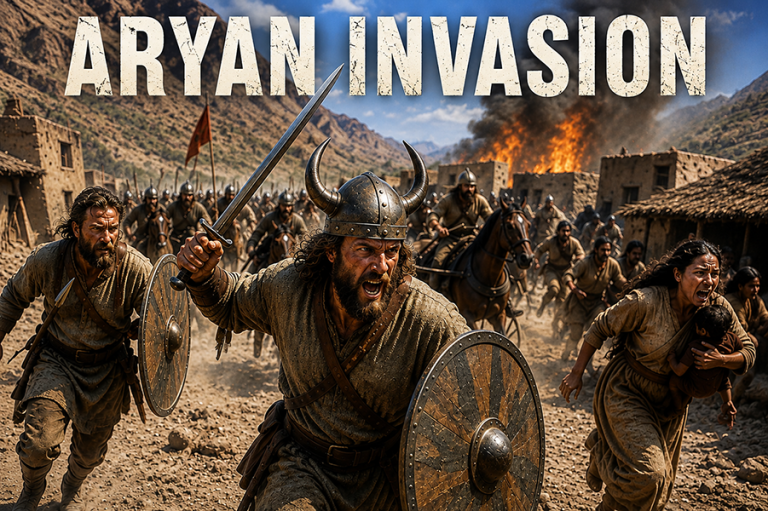
Balangir : 17 October 2026 : After the people of the Aryan race brought the oldest ‘Indus Valley Civilization’ under their control, they destroyed the original civilization and culture of India.
In the subsequent period, in order to bind India into religious slavery, after establishing Vedic culture on the basis of the Rigveda, they created the imaginary gods Brahma, Vishnu, and Maheshwar. Along with this, in the name of the gods and on the basis of the Rigveda, structuring the caste system and Brahmanism, the people of the Aryan race became Brahmins.
At that time, due to serious differences and ideological clashes among the Brahmins solely for serving their own self-interests, they got divided into two factions named Vaishnav and Shaiva communities.
The caste system and Brahmanism have been created by the Brahmins for the sake of the imaginary gods Brahma, Vishnu, and Maheshwar. Therefore, based on the Rigveda and through the Vaishnav community, the “dramatic story of the test of the Trinity (Brahma, Vishnu, and Maheshwar) by the Brahmin Maharishi Bhrigu” was composed in the Puranas to establish that the Brahmin is even more powerful than the gods.
For your perusal, detailed information related to this has been presented by dividing it into the following parts. Since the subject matter is very complex, it has to be studied with profound depth:
(1) Aryan Invasion, Rise of Brahmanism, and Structuring of the Caste System: A Historical Conspiracy :
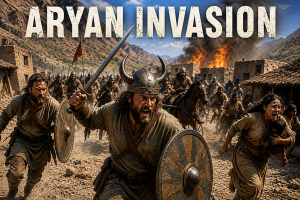
Between 2000-1800 BCE, a major historical disaster took place in the Indian subcontinent. Foreign Aryan invaders first entered the Indus Valley carrying the ‘Rigveda’ with them.
Their primary objective was to bring India’s highly advanced and oldest ‘Indus Valley Civilization’ under their control and completely destroy it. After obliterating India’s original civilization and culture, between 1500-1000 BCE, they made the Saraswati River valley their center and forcibly imposed their own ‘Vedic culture’ and rigid Brahmanism upon the Indians.
(a) Religious Slavery and the Creation of Imaginary Trinity:
The biggest socio-political strategy of the Aryans was to keep the indigenous inhabitants of India bound in mental and religious slavery forever; they wanted to govern not just at the physical level, but at the mental level.
To this end, based on the Rigveda, imaginary gods like Brahma, Vishnu, and Maheshwar were structured, so that an invisible religious fear and the foundation of superstition could be planted in the minds of common people.
(b) The Conspiracy of Purushasukta and the Beginning of the Caste System :
To give a sacred religious form to Brahmanism and social inequality, later on, a controversial verse named ‘Purushasukta’ was incorporated into the 10th Mandala, 90th verse of the Rigveda.
According to many historians, this verse was not present in the original Rigveda at all; rather, Brahmanists introduced it very intentionally to establish their own supremacy.
Through this verse, a deceptive explanation was propagated that Lord Brahma sacrificed a giant Purusha (who had a thousand heads, arms, and legs) in a yajna to structure the caste system.
It was depicted that Brahmins emerged from the mouth of that Purusha, Kshatriyas from the arms, Vaishyas from the waist, and Shudras from the feet. Through such extremely unscientific and untruthful stories, dividing society, the Aryan invaders themselves sat as the supreme ‘Brahmins’ of society.
From our editorial analysis, it is clear that the caste system present in Indian society is not any divine ordination, but rather a well-thought-out social and historical conspiracy.
Religion was used as a weapon to exploit the indigenous people, destroy their history, and establish the dominance of Brahmanism. Only by unearthing this historical reality can the path to building a truly egalitarian society be paved.
(2) Serious Differences and Disputes between Vaishnav and Shaiva Brahmin Communities :
The disagreements, differences, and disputes that arose in the past between the Vaishnav and Shaiva communities did not have just a single cause; rather, it was a mixture of religious, philosophical, social, and political causes. The main true causes of this are discussed below:
(a) Theological Difference regarding Ishtadeva and Supreme Entity:
The Fight for Supremacy : The main cause of dispute among these communities was ‘Who is supreme—Vishnu or Shiva?’ Since the Puranic era, opinions have been established in various texts regarding this. While Vaishnav texts (e.g., Vishnu Purana, Bhagavata Purana) depict Vishnu as the origin and root cause of all deities, Shaiva texts (e.g., Shiva Purana, Linga Purana) describe Shiva as ‘Mahadeva’ or the supreme God.
Avatar and Creation Theory : Vaishnavs believe that Vishnu is the preserver of the universe and he takes avatars repeatedly to protect righteousness. On the other hand, Shaivas view Shiva as the ultimate controller of the three acts—creation, sustenance, and dissolution—and as ‘Nataraja’ or ‘Yogeshwar’. This fundamental difference in belief often stood the two groups against each other.
(b) Royal Patronage & Power Dynamics :
King’s Religion and Influence: In ancient and medieval India, the religion or community adopted by kings regulated the wealth of the kingdom and the construction of temples.
For example, many rulers of the Chola and Pallava dynasties in South India were staunch Shaivas. As a result, Vaishnav saints (such as Alwar saints or Ramanujacharya) occasionally faced persecution or banishment from the kingdom during that time. Conversely, the reverse situation was seen during the Vijayanagara Empire or other Vaishnav rulers in subsequent periods.
(c) Control over Temples and Resources:
Dominance in Pilgrimage Centers: In Kashi, Haridwar, Prayag, and other major pilgrimage centers, major conflicts and armed fights (e.g., the Kumbh Mela dispute) occurred in the past over which community’s ascetics (such as Shaiva Naga Sadhus or Vaishnav Bairagis) would worship first, the order of procession in the fair, and who would hold the treasury and management of the temple.
(d) Royal Grants & Temple Wealth:
In ancient India, temples were not just places of worship; they were massive centers of financial, banking, and landed property.
Whenever a ruler showed more favor to a community (e.g., Shaiva), thousands of acres of tax-free land (Agrahara) and wealth from the royal treasury were granted to the temples and monasteries of that community.
Consequently, other communities (e.g., Vaishnav) felt economically and socially deprived, which created conflicts concerning temple management and property control.
(e) Armed Conflicts between Akhadars:
In medieval India, the Akhara institution was created to protect pilgrimage centers and temples and to increase the influence of one’s community.
Shaiva Ascetics (Naga Sadhus/Dashnami Sanyasis): Shaiva akharas organized by Adi Shankaracharya were operated by armed sadhus.
Vaishnav Bairagis (Nirvani Akhada): Vaishnav saints also formed their own akharas (such as Nirmohi, Nirvani, Digambar Akhada) to counter the influence of Shaivas.
(f) Shahi Snan Dispute in Kumbh Mela:
During the “Shahi Snan” at Kumbh Melas (Haridwar, Ujjain, Prayag, Nashik), fierce armed battles occurred multiple times over which community’s sadhus would bathe in the river first and lead the procession.
In the bloody conflicts between Shaiva Naga Sadhus and Vaishnav Bairagis during the Haridwar and Nashik Kumbh Melas in 1689 and 1760, thousands of sadhus lost their lives.
(g) Control over Historic Temples:
At certain historical sites, ownership claims were also made regarding whether the main deity of the temple was Shiva or Vishnu.
For example, regarding the presiding deity Sree Venkateshwara (Vishnu), Shiva, or Shakti (Durga) worshipped in the Tirupati Tirumala temple in Andhra Pradesh, differences of opinion arose. Subsequently, in the 12th century, Saint Ramanujacharya proved on the basis of scriptural evidence and agama principles that this is a form of Vishnu and established Vaishnav worship procedures.
(3) The Dramatic Story of the Trinity Test by Brahmin Maharishi Bhrigu:
During the Vedic era, a grand yajna was organized on the banks of the Saraswati River. Many great sages, saints, and Brahmins gathered to participate in it. Maharishi Bhrigu, the guru of the Brahmins, was also present there.
At that time, Maharishi Narada arrived from the sky and asked all the great sages, saints, and Brahmins among the Trinity gods—Vishnu, Brahma, and Shiva—who was the supreme, and to whom they should offer the primary offering (master) of that yajna. None of those present could decide the answer to his question.
With the unanimous consent of all the great sages and saints present, it was decided that Brahmin Maharishi Bhrigu would test and determine who among the Trinity is the supreme.
(a) Test of the Trinity by Maharishi Bhrigu: Curse on Brahma and Limitation of Temples:
Accepting this responsibility, Maharishi Bhrigu first decided to test Lord Brahma. He went to Brahmaloka to have an audience with Lord Brahma. Upon reaching Brahmaloka, the Maharishi intentionally showed extreme disrespect toward Lord Brahma.
Lord Brahma became angry and wanted to punish the Maharishi; however, his wife, Mata Saraswati, understanding the purpose of the Maharishi’s visit, protected him from Brahma’s anger. Angered by Brahma’s disrespect, Maharishi Bhrigu cursed that “in the Kali Yuga, no one will worship Brahma.” To this day, there are very few temples dedicated to Lord Brahma (with the Brahma temple of Pushkar being the sole exception).
(b) Test of Lord Shiva on Mount Kailash and the Background of Linga Worship:
After this, Maharishi Bhrigu decided to visit Lord Shiva on Mount Kailash. Upon reaching Mount Kailash, Nandi barred him from entering because Shiva and Parvati were engrossed in lovemaking at that time.
Being unable to meet him even after waiting for a long time, Maharishi Bhrigu cursed Lord Shiva that He would be worshipped only in the form of a Linga. In Kashi, only the Mahamrityunjaya temple has an idol form of Lord Shiva, which is said to be more than 400 years old.
(c) Strike on Lord Vishnu’s Chest in Vaikuntha Dham and Creation of the Srivatsa Mark:
After this, to test Lord Vishnu, the Maharishi arrived at Vaikuntha Dham. He entered the dham without Lord Vishnu’s permission and saw that Lord Vishnu was resting at that time. The Maharishi asked Him to get up, but the Lord was in deep sleep.
After waiting for a long time without seeing any response from the Lord, the Maharishi struck Lord Vishnu’s chest with his foot. That strike by Maharishi Bhrigu left a footprint on the Lord’s chest, and that footprint is known as “Srivatsa.”
After the strike, Lord Vishnu woke up and understood what had happened. Knowing that the Maharishi had inflicted a blow on him with his foot, the Lord asked him, “O Maharishi, is your foot hurt? My chest is strong, but your foot is not so strong.” Seeing this dignity of Lord Vishnu, Bhrigu was pleased and declared Him the supreme among the Trinity.
(d) Mata Mahalakshmi’s Anger and Curse on Brahmins:
According to Hindu scriptures, Mahalakshmi, the goddess of prosperity and wife of Lord Vishnu, was also present in that dham and witnessed the entire incident. She could not tolerate the disrespect shown to Lord Vishnu by Maharishi Bhrigu and cursed him that from today onwards she would never go to the Brahmins and they would all live in a state of poverty.
By worshipping Vishnu, the Brahmins will be freed from Mahalakshmi’s curse.
Hearing this curse from Mahalakshmi, the Maharishi explained the true purpose of his visit to her and repented. Thereafter, Mahalakshmi told the Maharishi that her curse would chase the Brahmins, but whenever any Brahmin worships Lord Vishnu, he will be freed from the curse.
This story has been created to generate faith so that priests, ritualists, or “Desharth Brahmins” (who transformed from various linguistic tribal communities or priestly classes through the Vedic caste system) continue the worship of Vishnu for the attainment of wealth.
It is clear from the above story that Rishi Bhrigu, the key architect of Brahmanism, cursed that Shiva should be worshipped not in a human body form, but in the form of a Linga.
This also implies that the Brahmin Bhrigu is more powerful than the gods, and due to this reason, Linga worship is practiced by followers of Sanatan Dharma to the present day.
(4) Scriptures in which the Mythological Episode of Maharishi Bhrigu’s Trinity Test is Recorded:
It is recorded in detail mainly in two major texts:
(a) Srimad Bhagavatam: This is the most prominent and famous source.
Chapter: This story is described in Canto 10, Chapter 89.
Description: In this, Maharishi Shukadeva Goswami narrates this episode to Maharaja Parikshit. All the details of the organization of a yajna by sages on the banks of the Saraswati River, entrusting Maharishi Bhrigu to resolve doubts, and his journey to the three worlds—namely the abodes of Brahma, Shiva, and finally Vishnu to conduct tests—are very beautifully recorded in it.
(b) Padma Purana:
Chapter: This subject is also detailed in the Uttara Khanda, Chapter 255 of this text.
Description: This also provides information on Bhrigu’s test of the Trinity, Vishnu’s immense forgiveness, and the subsequent mythological story associated with Mother Lakshmi.
(5) Underlying Objective of Composing the Mythological Episode of Maharishi Bhrigu’s Trinity Test:
Various episodes described in ancient Sanatan Dharma and Puranic literature are not limited merely to devotion or spirituality; rather, a deep history of social, political, and sectarian influence expansion lies behind them.
In this context, the story of the test of the Trinity (Brahma, Vishnu, and Maheshwar) by Maharishi Bhrigu is widely discussed, and there are various opinions regarding its underlying objective.
It is analyzed that this dramatic mythological story was composed with the objective of establishing the dominance of the Vaishnav community and diminishing the influence of other communities. The various aspects of this narrative and its consequences can be studied as follows:
(a) Decline of the Brahma Community and Restrictions on Worship:
According to the mythological story, based on the incident of Brahma getting angry during Bhrigu’s test and subsequently becoming the victim of Brahmin Maharishi Bhrigu’s curse, a kind of restriction was placed on the independent worship of Brahma in the mortal world.
As proof of this, independent temples of Brahma are extremely rare in India (such as the temple located in Pushkar, Rajasthan). Through this story, the influence of the Brahma community in society was gradually diminished.
(b) Shaiva Community and Social Transformation of Linga Worship:
Another perspective behind this narrative is that to curb the influence of the Shaiva community, the tradition of worshipping Shiva in the form of a ‘Linga’ instead of physical idol worship was brought forward.
The underlying ideology behind this was that ordinary people would not accept it. However, due to the immense faith, devotion, and belief of ordinary masses toward Lord Shiva, people accepted this symbolic ‘Linga worship’ with utmost sanctity, which further strengthened the Shaiva stream.
(c) Supremacy and Economic Influence of the Vaishnav Community:
Through this story, Lord Vishnu was established as ‘sattvik’ and supreme among the Trinity. Along with this, a religious fear was also created that those who do not worship Vishnu would become victims of Mahalakshmi’s curse and turn destitute. For this reason, in the hope of attaining wealth and prosperity, a large section of society became more attracted toward the worship of Vishnu and Lakshmi.
( d ) Supreme Authority of Brahmins or Sages:The most prominent aspect of this entire episode is the assertion of the supreme power of Brahmins or sages in society. It was depicted here that Brahmin maharishis can travel to divine places like Brahmaloka, Vaikuntha Dham, and Mount Kailash in their very physical human bodies.
Not only that, a powerful religious message was instilled in the public consciousness that they possess not just the capacity to test the destiny of deities, but also the ability to punish deities if they act against rules.
Viewed holistically, this mythological episode of Maharishi Bhrigu’s Trinity test is not merely an imaginary story, but rather a well-thought-out socio-religious strategy of ancient times to establish religious supremacy, sectarian influence, and the hegemony of Brahmanism in society.