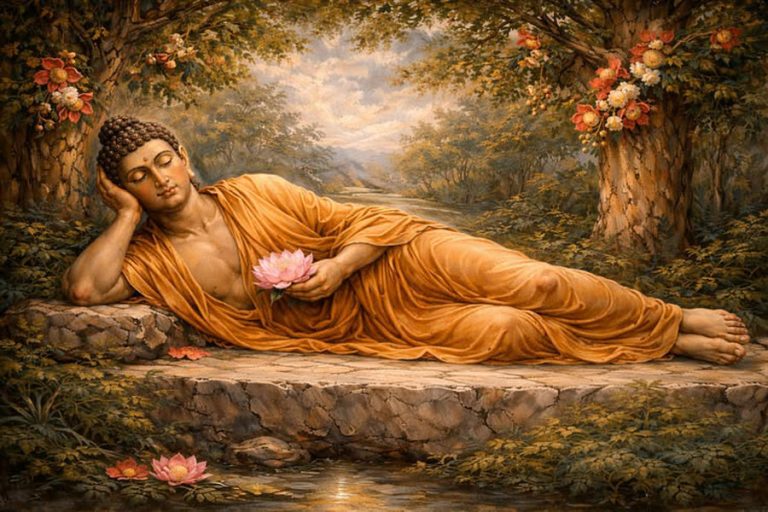
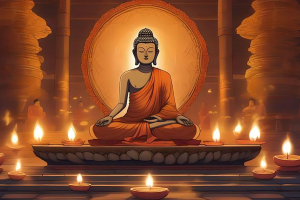
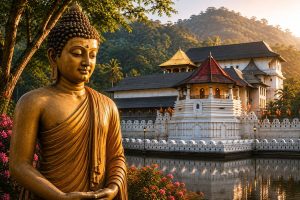
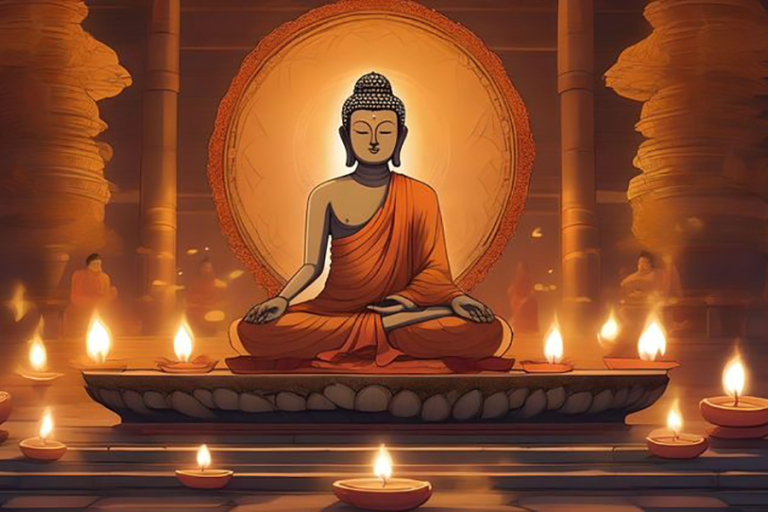
Balangir : 08 November 2026 : To commemorate the day Lord Gautam Buddha attained enlightenment, the Festival of Lights or Deepadan Celebration was first celebrated every year in his native land, the Shakya Empire.
After Emperor Ashoka embraced Buddhism, ‘Deepavali’ was celebrated as the most prominent festival across the entire Maurya Empire. Following the fall of the Maurya Empire, the Brahmanical era returned, leading to the destruction of Buddhism.
To re-establish the caste system and Brahmanism, millions of Buddhist monks and nuns were massacred, and the ancient history and culture of the country were distorted.
During that time, various fictitious mythological stories were created to transform Buddha’s Deepadan festival into the Brahmanical festival of Deepavali. Detailed information on this subject matter is presented below:
(1) Gautam Buddha’s Enlightenment and the Deepadan Mahotsav:
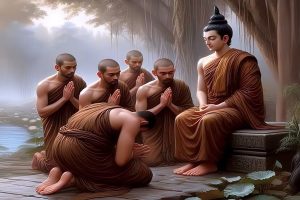
After attaining enlightenment at Bodh Gaya, on the day Lord Gautam Buddha returned to Kapilavastu, as per the directives of his father, Shakya Emperor Suddhodana, lamps were lit and fireworks were burst across the entire Shakya Empire to welcome and felicitate him.
Subsequently, to commemorate the day Gautam Buddha attained enlightenment, the Deepadan celebration was observed every year across the Shakya Empire by lighting lamps and bursting fireworks.
Since the darkness of ignorance was dispelled and the light of knowledge was kindled in the country after Gautam Buddha’s enlightenment, the Deepadan festival was also referred to as the Festival of Lights.
(2) The Kalinga War and Emperor Ashoka’s Transformation from Chandashoka to Dharmashoka:
Emperor Ashoka emerged victorious in the Kalinga War in 261 BCE. However, he was deeply grief-stricken and distressed by the heart-wrenching horrors of the war.
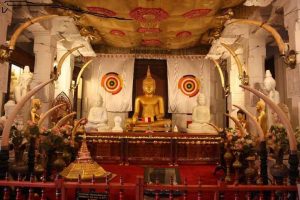
Coming into contact with Buddhist monks and inspired by their ideology, Emperor Ashoka stayed at Dantapura in Kalinga, embraced Buddhism at the Buddhist Stupa situated there, transformed from Chandashoka to Dharmashoka, and renounced weapons forever.
(3) The World’s Most Powerful Buddha’s Country and the Celebration of the Deepadan Festival:
(a) The World’s Most Powerful Buddha’s Country: During the 36-year long reign of Emperor Ashoka between 268 BCE and 232 BCE, the Maurya Empire was recognized across the world as the largest, most prosperous, and powerful Buddhist empire. At that time, approximately 95 percent of the citizens of the Maurya Empire were followers of Buddhism.
To commemorate the day of Buddha’s enlightenment, the ancient tradition of the Deepadan festival was celebrated grandly as the Festival of Lights every year across the entire Maurya Empire.
(4) The Decline of Buddhism and the Return of the Brahmanical Era:
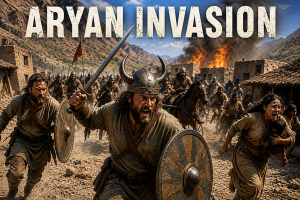
(a) Betrayal and Decline: In 185 BCE, the ninth and last emperor of the Maurya dynasty, Brihadratha Maurya, was assassinated through deceit and treachery by his Brahmin general, Pushyamitra Shunga, bringing a permanent end to the Maurya Empire.
(b) Atrocities on Buddhism: After ascending the throne as the first ruler of the Shunga Empire, Pushyamitra Shunga re-established Brahmanism in the country. All the military power of the state was deployed to destroy Buddhism, leading to the decline of Buddha’s religion and the return of the Brahmanical era.
(c) Brahmanicals in the Council of Ministers: From that period onwards, in royal courts, Buddhist monks were replaced by Brahmins in the council of ministers. Under their instigation, millions of Buddhist monks and nuns were brutally massacred to completely eradicate Buddhism from the country.
(d) Distortion of Ancient History and Culture: All 84,000 Buddhist statues, stupas, viharas, and places of worship built by Emperor Ashoka were completely destroyed. Many of Buddha’s sacred shrines were captured by Brahmanicals and converted into temples. To perpetuate Brahmanism and the caste system in the country, ancient history and culture were distorted.
(5) Creation of Fictitious Stories and the Transformed Brahmanical Deepavali Festival:
In subsequent times, many Puranas were composed based on fictitious stories, transforming the age-old tradition of the Deepadan festival (or Festival of Lights)—meant to commemorate Buddha’s enlightenment—into the Brahmanical festival of Deepavali.
The main mythological stories and traditions behind the celebration of the Deepavali festival include:
(a) Lord Rama’s Return to Ayodhya: According to the Ramayana (Valmiki Ramayana and Tulsidas’s Ramcharitmanas), the most famous fictitious story associated with the Brahmanical Deepavali festival is the return of Lord Rama to Ayodhya. After completing 14 years of exile and slaying the symbol of unrighteousness, Ravana of Lanka, Lord Rama returned to Ayodhya along with Goddess Sita and Lakshmana. The residents of Ayodhya celebrated by lighting earthen lamps across the city to welcome their beloved prince.
(b) Slaying of Narakasura by Lord Krishna: According to mythological accounts, a tyrannical demon named Narakasura tormented deities and women and imprisoned many princesses. On Chaturdashi tithi of Kartik month (known as Naraka Chaturdashi), Lord Krishna, along with his wife Satyabhama, slew Narakasura and liberated 16,100 princesses. People rejoiced and lit lamps following the demon’s death.
(c) Worship of Goddess Lakshmi and Lord Ganesha: On the night of Deepavali Amavasya, Goddess Lakshmi (the goddess of wealth) and Lord Ganesha (the god of wisdom and intellect) are worshipped. It is a religious belief that Goddess Lakshmi emerged from the cosmic ocean during Samudra Manthan on Kartik Amavasya.
(d) Return of the Pandavas: According to the Mahabharata, after spending 12 years of exile and 1 year of incognito living (Agyatvas) after being craftily defeated by the Kauravas, the Pandavas returned to Hastinapura on Kartik Amavasya, prompting the citizens to celebrate by lighting lamps.
(6) Lack of Historical Reality in Mythological Stories:
In the age of science and archaeology, these mythological stories cannot be accepted as truth or historical events. The years, times, and events described in the so-called Puranas lack any scientific or solid historical foundation. They are entirely based on imaginary, spiritual, and symbolic sentiments.
After the destruction of Buddhism, to perpetuate Brahmanism and the caste system in the country, true history and culture were distorted based on the aforementioned fictitious stories, transforming Buddha’s Deepadan festival into the Brahmanical Deepavali festival. Since that time, the Deepavali festival has been celebrated every year on Kartik Amavasya by worshipping the imaginary deities of the Brahmanical religion.