
Balangir : 17 July 2023 : Since the days of Asoka in 3rd century B.C. Puri district as a whole became the cradle of Buddhism. A Buddhist establishment, perhaps a stupa containing Buddhist relics was known to have been stationed there . All sources agree that an abode or Stupa was existed at Puri about 950 A.D.
Many scholars believe that Puri was an ancient seat of Buddhist cult. The reference to Buddha’s Tooth Relics of Kalinga , conversion of Asoka to Buddhism in Puri district lend support to this contention.
Scholars are of the opinion that when Gaya was a principal centre of Buddhism, Puri was also flourishing as an equally important centre devoted to Buddhism. According to them, before Vaishanavism influenced Buddhism, Orissa was already under the influence of Buddhism.
The relic in India
According to Sri Lankan legends, when the Buddha died, his body was cremated in a sandalwood pyre at Kusinara in India and his left canine tooth was retrieved from the funeral pyre by Arahat Khema.
Khema then gave it to King Brahmadatte for veneration. It became a royal possession in Brahmadatte’s country and was kept in the city of Dantapuri (present day Puri in Orissa).The king build a stupa to house the sacred tooth relics .
It was worshipped by the then emperor of Kalinga at Dantapuri i.e. present Puri. It is well known that Buddhists never believed in caste or Varnas and consider to be very low, are also treated on equal terms .
So in Buddhist Stupa at Dantapuri High and low castes were enjoined to eat the mahaprasada together. Here all are equal as the barriers of caste, race and faith were transcended.
In order to Commemorate the day of enlightenment of Gautam Buddha, the Buddhists Installing the relic in a chariot the car festival was being celebrated every years at Dantapuri .
Buddhism does not believe in any class or caste distinction. During the car festival and other festivities, caste distinction was not found .
Before 2500 years, King Suddhodhan of Sakya clan was ruling Kapilvastu.Suddhodhan had two wives. One of them was Mayadevi and another was Prajapati. After some days of Suddhodhan and Prajapati marriage , Mayadevi conceived and after giving birth to a boy, Mayadevi died in a very short time.
The boy was nurtured by Mayadevi’s sister Prajapati and named as Siddhartha. Later on he became famous as the Gautama Buddha.
This Aunty Goutami Prajapati is the step mother of Buddha, So during the festival Buddhist’s car was going upto the Aunty’s house.The practice of visiting to Aunty house at Puri points to the fact that the yatras had a Buddhist origin.
A belief grew that who ever possessed the Sacred Tooth Relic had a divine right to rule that land. Wars were fought to take possession of the relic. 800 years after the Buddha’s death, in the 4th century CE, the tooth came into the possession of King Guhaseeva of Kalinga, which roughly corresponds to the present day state of Orissa.
Kalinga had become a Buddhist and begun to worship the Sacred Tooth relic. This caused discontent among some of Brahmins and their followers , who went to King Paandu and said that King Guhaseeva had stopped believing in god and that he had started to worship a tooth reric.
The wrath of the Brahmins and their followers, made many kings from other lands that supported them, come into war with King Guhaseeva.
King Paandu decided to destroy the relic, and ordered to it brought to the city. The ‘ Dāṭhāvaṃsa ‘ recounts the tale of a war fought over the relic 800 years later between Guhasiva of the republic of Kalinga and a king named Pandu. It is said that, during the war a miracle occurred, and King Paandu converted to Buddhism.
When King Ksheeradara heard King Paandu has converted to Buddhism., he went with his army to attack Paandu in the city of Palalus. The invaders were defeated before reaching the city, and King Ksheeradara died.
A prince from the city of Udeni who had become a Buddhist came to worship the sacred tooth. King Guhaseeva was pleased with him, and let him marry his daughter. The prince was known as Dantha and the princess as Hemamala.
When they heard that King Ksheeradara had died in the war, his sons raised a large army to attack King Guhaseeva and destroy the relic. They entered the city, but King Guhasiva secretly sent Dantha and Hemamala out of the city, with the relic.
The relic in Sri Lanka
According to legend, Hemamali hid the relic in her hair ornament and the royal couple disguised themselves as Brahmins in order to avoid discovery. They set sail from Tamralipti, a port at the mouth of the river Ganges, and landed in Sri Lanka at the port of Lankapattana (now Ilankeiturei).
It is said that Sri Lanka was chosen as the new home for the tooth relic because the Lord Buddha had said that the religion will be safe in Sri Lanka for 2500 years.
At the time, King Kirti Sri Megavanna or Kithsirimevan ruled Sri Lanka. The King was overjoyed when he heard the news and warmly welcomed the royal couple and received the Sacred Tooth Relic with great veneration.
He built a beautiful palace within the Royal Palace Complex itself and enshrined the Relic in it. Thereafter, he ordered that an annual perahera be held in honour of the Sacred Relic.
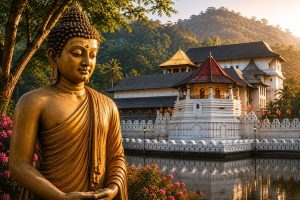
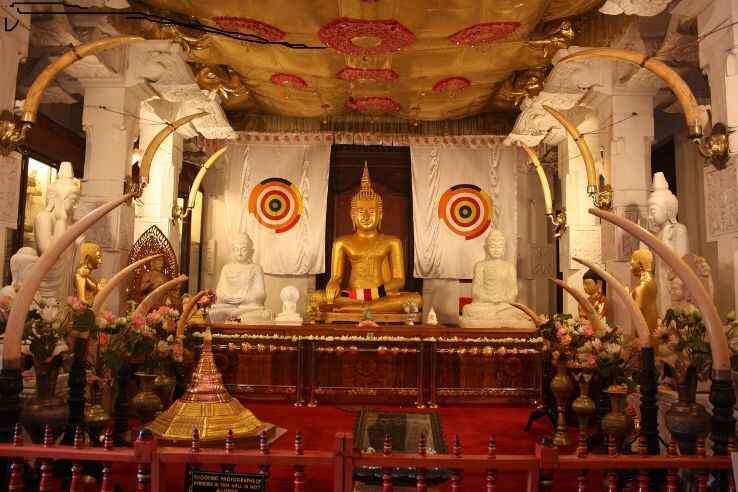
As time went on, as the land was threatened with foreign invasions, and the seat of the kingdom shifted from Anuradhapura to Polonnaruwa and thereafter to Dambadeniya and other cities. With every change of capital, a new palace was built to enshrine the Relic. Finally, it was brought to Kandy where it is at present, in the Sri Dalada Maligawa temple.
The Sacred Tooth Relic came to be regarded as a symbolic representation of the living Buddha and it is on this basis that there grew up a series of offerings, rituals, and ceremonies.
These are conducted under the supervision of the two Mahanayake Theros of Malwatte and Asgiriya Chapters and the Diyawadana Nilame of the Maligawa. They have a hierarchy of officials and temple functionaries to perform these
Other tooth relics
Aside from this specific tooth relic, another relic of the tooth of the Buddha is currently in Ling Guang Temple in Mainland China, and Fo Guang Shan monastery in Taiwan. The Shari-Den shrine of Engakuji temple in Kamakura, Japan, is also reputed to contain a tooth relic .
In order to Commemorate the day of enlightenment of Gautam Buddha, presently also Buddhists Installing the relic in a chariot the car festival was being celebrated every years in the above counties Buddhist Establishment where tooth relic exists .