
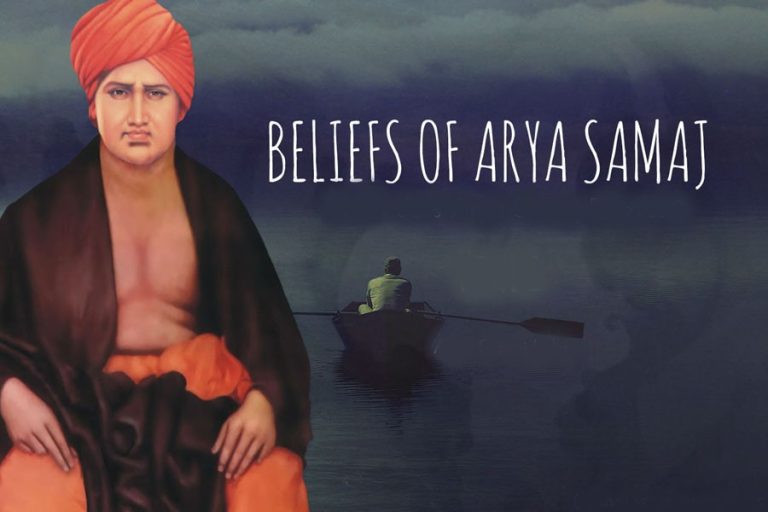
Balangir : 22 June 2023 : Swami Dayananda Saraswati was an Indian philosopher and social reformer who is best known for being the founder of a social reform movement called “ Arya Samaj “.
The founding principles of the Arya Samaj are equality and justice for all individuals; irrespective of their caste, class, gender, and nationality. Arya Samaj has enshrined its main ideal as –
” All actions should be performed with the prime objective of benefiting mankind.”
Early life :
Dayananda was born as Mul Shankar Tiwari into an affluent Brahmin family in Tankar, Gujarat. His father, Karshanji Lalji Kapadi was an influential person who worked in the Company Raj as a tax-collector. He spent his childhood in luxury .
His family was an ardent follower of Lord Shiva ans had started grooming him in various Brahmanical rituals, piety and purity, and the importance of fasting from a very early age.
When Mul Shankar was eight years old, the ceremony of ‘Yajnopavita Sanskara’ (the investiture of the “twice-born”) was performed, and thus, Mul Shankar was formally inducted into the world of Brahmanism.
By the age of 14, he had become a respected figure in his locality and had started reciting religious verses and taking part in religious debates. Reportedly, during one such debate on 22 October 1869 in Varanasi, which was attended by over 50,000 people, Mul Shankar defeated 27 scholars and 12 expert pandits. The main topic of the debate was “Do the Vedas uphold deity worship?”
The inquisitive Mul Shankar started observing these rituals with much honesty and soon, he himself became an ardent follower of Lord Shiva. He would often sit awake the whole night in front of the idol of Lord Shiva. During one such night of Shivaratri (a Hindu festival, which is considered the wedding night of Lord Shiva and Parvati) in 1838, he observed that a mouse climbed the Shiva Linga and started eating the offerings of God.
This incident made him ponder over the existence of God, and he questioned that if Lord Shiva could not defend himself against a tiny mouse, then how could he be called as the saviour of the world. The mouse incident of that Shivaratri night gave a new direction to Mul Shankar’s thoughts towards religion, especially Hinduism, and he started questioning his parents about religion and various prevailing rituals.
The desire to take Sanyasa (an ascetic life) had first come to him at the age of 14 when he witnessed the incidents of his sister’s death, who was two years younger to him, due to cholera, and one of his uncle’s death cemented his disbelief in pointless rituals and idolatry. After seeing their lifeless bodies, he told himself,
” I shall also have to face death one day. I must devote myself to the path of salvation.”
To divert his mind, his parents engaged him in his early teens, but Mul Shankar didn’t want to get married, and he ran away from his home in 1846. He relinquished the material comfort and started wandering as an ascetic.
After his Diksha (baptism) from Swami Purnananda Saraswati on the banks of Narmada, he became a formal Sanyasi at the age of 24. It was Swami Purnananda who gave him the name Dayananda Saraswati.
After his baptism, he started participating in debates with several scholars across the country. During this time, he met Swami Virjananda in Mathura and became his disciple. Virjananda himself was a critic of the prevailing orthodox in Hinduism, and he encouraged Dayananda to read the Vedas. During his last days, Swami Virjananda told Dayananda to –
” Destroy the avidya (ignorance) about the Vedas and spread the true Vedic dharma in the world.”
Inspired by the teachings of Swami Virjananda, Dayananda decided to devote his entire life for removing the impurities in Hinduism.
Dayananda Saraswati travelled across India to spread the message of the Vedas, including the Vedic ideals of Brahmacharya (celibacy) and devotion to God. He called the entire nation to ‘return to the Vedas.’ His “back to the Vedas” message had a deep impact on many philosophers and thinkers of that time.
During a short visit in Calcutta, he met Ramakrishna Paramahansa (guru of Swami Vivekananda) and the founder of Brahmo Samaj Keshav and his followers.
However, he didn’t agree with their philosophies and after his Calcutta visit, he established the Arya Samaj on 10 April 1875 in Bombay, an organization which went on to become the first Hindu organization to introduce proselytization in Hinduism.
Dayanand’s mission :
The Arya Samaj provided valuable services to Hindu society by opposing various social evils. He was an outspoken opponent of the caste system and the Brahmins’ social superiority.
He also questioned the Brahmins’ monopoly on reading the Vedas and advocated for the right of all people, regardless of caste, creed, or color, to study the Vedas.
Dayananda was also a vocal opponent of the practice of untouchability. He advocated for female education and protested against women’s injustices.
It has worked to further intercaste marriages , interdining, built missions, orphanages, and homes for widows; undertaken famine relief and medical work.
He was adamantly opposed to child marriages , polygamy, purdah, and the practice of ‘Sati,’ among other things. He demonstrated that women should have equal rights with men by citing Vedic teachings.
Dayananda was the first to advocate “Swadeshi,” or the rejection of foreign goods. He also coined the term ‘Swaraj’ to refer to a state founded on Vedic principles before any Indian national leader did.
He aided the development of an all-India national spirit by recognizing Hindi as the national language.
His clarion call to “Return to the Vedas” raised awareness among the people. Other scriptures and Puranas were rejected by him.
Dayananda also encouraged followers to question existing beliefs and rituals instead of blindly follow them.
He gave new interpretations to reform the stagnant Hindu thought through his book “Satyaprakash” (The Light of Truth).
Views on superstitions :
He spent his entire life criticising the prevailing dogma and superstition in Hinduism at the time and heavily voiced his opinion against the pointless rituals, idolatry, animal sacrifice, meat-eating, offerings made in temples, priestcraft, pilgrimages, worship of murtis (images) , the concept of heaven and hell & fatalism.
shraddha (rituals on behalf of ancestors) , Relics immersion , bathing in the Ganges River and feeding of priests on anniversaries, which Dayananda pronounced as superstitions or self-serving practices. He also exhorted Hindus to accept social reforms, including the importance of cows for national prosperity .
He also encouraged followers to question existing beliefs and rituals instead of blindly follow them.
Dayananda also heavily criticised the superstitious practices, such as sorcery and astrology.
Arya Samaj :
The founding principles of Arya Samaj became a fervent supporter of Hinduism and an organ of militant Hinduism . The Arya Samaj was instrumental in bringing about socio-religious changes in pre-independence India.
Some of the reforms introduced in the Indian Constitution had been inspired by his teachings.”
In 1962, the Government of India released a postal stamp to honour Dayananda Saraswati .
Today, the Arya Samaj has its presence in many countries across the globe, such as the United States of America, Canada, Trinidad, Mexico, United Kingdom, and the Netherlands.
Views on other religions :
Dayananda is also known for his critical analysis of other religions also, such as Christianity, Islam, Buddhism, and Jainism.
He was also criticized as a conservative and sectarian activist who claimed Hinduism’s superiority over all other religions, and as having exhibited an aggressive intolerance toward both Christianity and Islam. In truth, he was not opposed to Christianity or Islam,but rather to the evil practices of all religions.
Assassination attempts :
Reportedly, before his assassination in 1883, many unsuccessful attempts had already been made. His supporters believe that he survived many attempts of giving poison to him because of his regular practice of Hatha Yoga.
Assassination :
Due to his radical thinking and approach to the social issues and beliefs Dayanand Saraswati created many enemies around him.
In 1883, on the occasion of Diwali Dayananda was poisoned while staying at the palace of the Maharaja of Jodhpur, Jaswant Singh II .
He became bed-ridden and after several days of pain and suffering, he died on the morning of 30 October 1883 in Mount Abu , where he was transported for medical treatment. He was 59 years old at the time.
Shuddhi Movement :
Just like the activities of proselytisation by Christian missionaries and Muslim teachers, which Dayananda had himself criticized, he introduced a new weapon called Shuddhi or the re-conversion ceremony.
“Shuddhi Movement” used to convert people of other religions to Hinduism and to re-convert those who had converted from Hinduism to other religions. This campaign discouraged low-caste Hindus from converting to Christianity or Islam.
The Shuddhi Movement opposed Christian missionaries who attempted to convert Hindus who were uneducated, poor, and depressed.
Educational Reforms :
For the education of both males and females, the Arya Samaj established a number of educational institutions such as Gurukuls, Kanya Gurukuls, D.A.V. Schools, and Colleges.
These educational institutions safeguarded Hindu religion and society while also promoting the advancement of knowledge and education in the modern scientific line.
Maharishi Dayanand was fully convinced that the lack of knowledge was the main culprit behind the adulteration of Hinduism. He set up a number of Gurukuls to teach his followers the knowledge of the Vedas and for them to spread the knowledge further.
Inspired by his beliefs, teachings and ideas, his disciples established the Dayanand Anglo Vedic College Trust and Management Society, after his death in 1883.
Many institutions were named after him, such as hundreds of DAV schools and colleges, Maharshi Dayanand University (MDU) in Rohtak, DAV University in Jalandhar, and many more.
Legacy :
Today, the Arya Samaj is very active not only in India but also in other parts of the world. The United States, Canada, Trinidad, Mexico, United Kingdom, Netherlands, Kenya, Tanzania, Uganda, South Africa, Malawi, Mauritius, Pakistan, Burma, Thailand, Singapore, Hong Kong, and Australia are some of the countries where the Samaj has its branches.
Although Maharishi Dayanand and the Arya Samaj were never involved in the Indian Independence Struggle directly, his life and his teachings had considerable influence in several important personalities like Lala Lajpat Rai, Vinayak Damodar Savarkar, Madam Cama, Ram Prasad Bismil, Mahadev Govind Ranade, Madan Lal Dhingra and Subhash Chandra Bose. Shaheed Bhagat Singh was educated at the D.A.V. School in Lahore.